
The MOQ Scope Checklist for a Kids-Safe Fragrance Line
Two quotations can carry the same minimum order quantity and buy completely different amounts of work. One includes the compound, the filling and the paperwork; the other includes the compound and leaves the bottle, the testing and the documentation to be arranged separately. For a kids-safe fragrance line, that difference is where the budget actually goes, because screening, stability work and declaration data are not incidental extras — they are the evidence that lets the product be sold at all. Read every quote as a scope, not as a number.
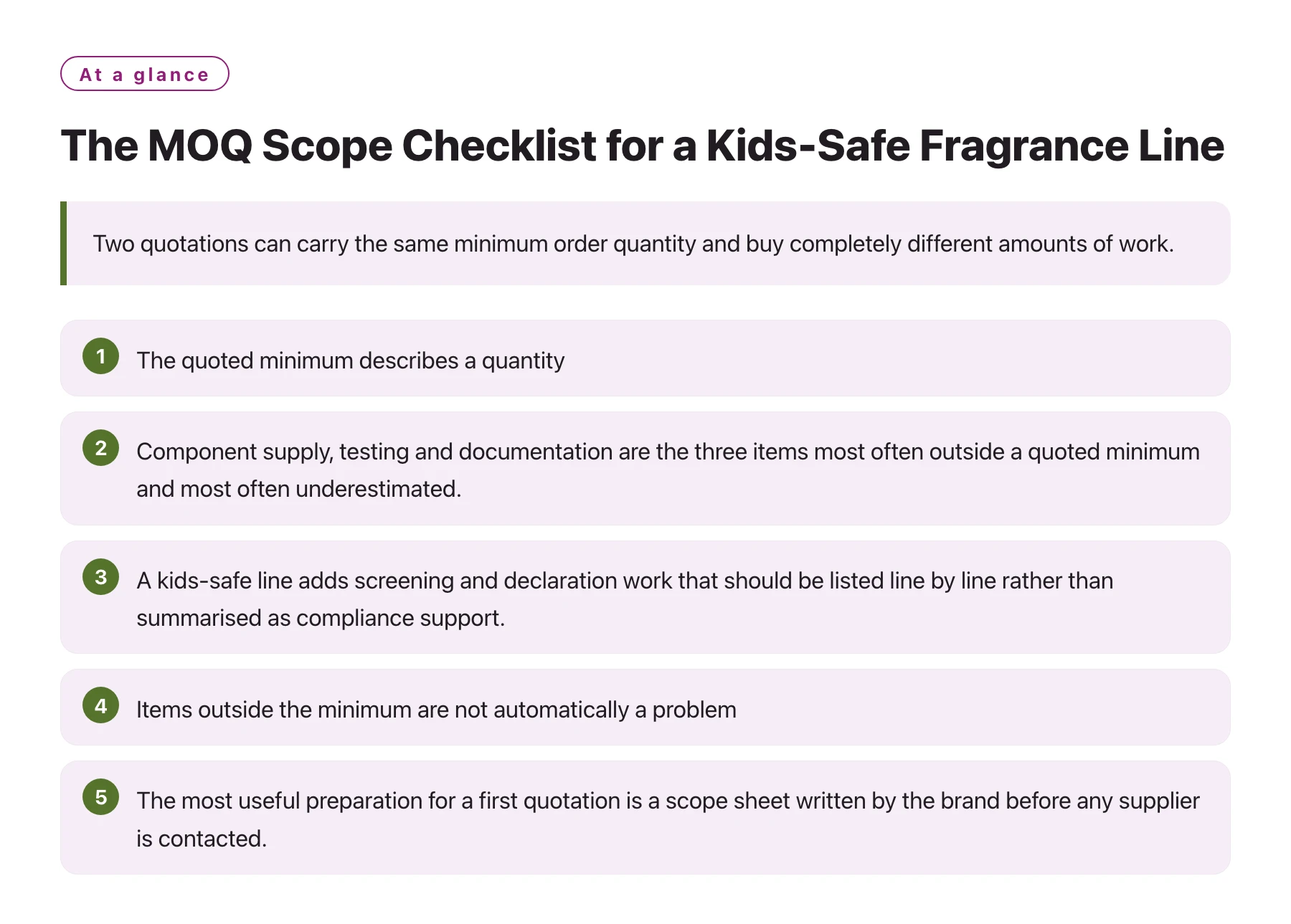
Key takeawaysThe quoted minimum describes a quantity, while the quotation describes a scope; only the scope explains the price. · Component supply, testing and documentation are the three items most often outside a quoted minimum and most often underestimated. · A kids-safe line adds screening and declaration work that should be listed line by line rather than summarised as compliance support. · Items outside the minimum are not automatically a problem, but they need owners, budgets and dates on the brand side. · The most useful preparation for a first quotation is a scope sheet written by the brand before any supplier is contacted.
Product developers tend to approach a first quotation looking for a unit price and a minimum. The unit price is easy to compare and almost never comparable, because the two suppliers have priced different bundles of work.
A scope sheet fixes that. Written before the first supplier call, it lists everything the project needs and marks each item as expected-inside, expected-outside or undecided. The quotation then either confirms the assumption or exposes it, and both outcomes are useful.
Where each line item usually sits
| Line item | Typically inside a quoted minimum | What it depends on |
|---|---|---|
| Fragrance compound and compounding | Yes, in most manufacturing quotations | Whether the scent is developed for you or taken from a library, and whether the smallest batch size supports your volume |
| Filling, crimping and assembly | Usually, when the partner runs a filling line | Whether the pack is standard for the plant; unusual closures or very small packs may be filled by hand at a different cost |
| Bottle, closure and pump supply | Sometimes, depending on the partner's sourcing model | Whether the partner holds stock components or sources to order, and whether the brand intends to supply its own |
| Outer carton and print | Sometimes; print is frequently separate | Print run minimums, number of SKUs and whether artwork is supplied print-ready |
| Screening against category restrictions | Often assumed rather than quoted | The intended user and product format, because the applicable limits differ by category |
| Stability and compatibility testing | Rarely inside a basic minimum | Test duration, the number of conditions and whether the finished pack or the concentrate is tested |
| Declaration data for the label | Varies; ask specifically | The destination market and the format the label designer needs |
| Shipping documentation and export papers | Usually the brand's responsibility | The destination market and the trade term agreed in the offer |
If a quotation does not say whether a line is in or out, treat it as out and budget for it; discovering an inclusion is a pleasant surprise, while discovering an exclusion is a schedule problem.
Reading the scope behind a kids-safe quotation
A kids-safe format changes the scope in two places. The first is screening: because fragrance materials are assessed against the product category and the way the product is used, the screening work is specific to your format and cannot be inherited from a scent's original application. The second is packaging, where the primary pack may need to satisfy rules that go beyond appearance. Packaging waste regulation in Europe, for example, is pushing brands toward lighter, more recyclable primary packaging with clearer material information [1], and a pack decision made purely on looks in a first quotation can become a compliance discussion later.
The industry body that represents cosmetics manufacturers in Europe maintains public material on how cosmetic products are regulated and how the sector frames safety and labelling obligations [2]. Reading that material before a supplier conversation shifts the questions from whether a product can comply to who supplies which piece of evidence, which is a much faster conversation.
This is also the point where a product developer should decide how far the partner's reach should extend. Choosing a full ODM fragrance service means the partner develops the scent and produces it, which reduces the number of interfaces on a first launch but also reduces how much of the product is uniquely yours. Deciding that trade before the quotation arrives is easier than reversing it afterwards.
Convert the scope into a question list
Every row in the table above becomes one question: is this inside the quoted minimum, and if not, what would it cost to add it? Sending that list before the call turns a sales conversation into a scoping session, and it gives the supplier a fair chance to price work it might otherwise have left unmentioned.
Decide what you will not outsource
Some items are cheaper to keep in-house. Artwork adaptation, market-specific copy and retailer documentation are typical examples, because they depend on information the brand already holds. Writing them down as retained items stops them drifting back into the supplier conversation and then into the price.
A five-step preparation sequence before you request quotes
- Write the product definitionFormat, application method, intended user and destination market, in one paragraph. Every screening and labelling question depends on this paragraph, so an unclear definition produces an unclear quotation.
- List every deliverableInclude the compound, the primary pack, decoration, the closure, the carton, testing, declaration data and shipping documents. Aim for completeness rather than brevity at this stage.
- Mark each item in, out or undecidedThis is the assumption you are testing. It is also the document you send with the brief, so the supplier prices against your understanding rather than theirs.
- Set the quantity rangeGive a first-order quantity and a twelve-month estimate. Partners price better when they can see the intended rhythm of orders rather than a single run.
- Add the documentation you must holdState the certificates and declarations your market requires, in the language and format you need. Asking for these at quotation stage is normal and avoids a late scramble.
Two preparations that shorten the scope conversation
Programmes that cover professional scent training help a product team write a tighter brief, because the vocabulary of materials makes the difference between a scope item and a preference much easier to state. A developer who can say which part of a formula is doing the work writes fewer words and gets clearer answers.
If the launch is the first for the company, the overview of what it takes to launch a perfume brand is a reasonable starting point for the items that belong on the sheet, since it lists the decisions a first project has to make regardless of who manufactures it. Read it for the checklist rather than for the advice, and add anything specific to your format, your market or your channel.
A practical cross-check once the quotations arrive: compare two offers line by line against your scope sheet and mark where the supplier assumed something you did not. Anywhere the two disagree is a question worth asking before price. Manufacturers who have done this many times publish their service description openly — the Xuelei official website lays out one such scope — and reading a described scope is a useful rehearsal before you write your own.
Sources
- European Commission: Packaging Waste and the PPWR —— EU rules on packaging and packaging waste, including the Packaging and Packaging Waste Regulation requirements on recyclability and design.
- Cosmetics Europe —— The European trade association for the cosmetics and personal care industry, publishing guidance, positions and market information.
Frequently asked questions
Should the scope sheet be shared with suppliers?
Yes, in most cases. It sets the terms of the conversation and makes quotations comparable. Keep the commercial assumptions out of it if you prefer, but keep the deliverables in, because that is what you are asking to be priced.
How do we know if screening is included in the quoted minimum?
Ask directly, and ask for the deliverable: a screening record issued against your formula revision and your product category. An affirmative answer without a document is an assumption rather than an inclusion.
Is it cheaper to arrange testing ourselves?
Sometimes, particularly if you already work with a laboratory. The trade is coordination: a manufacturer running its own testing can usually move faster, while an independent laboratory may be easier to use as neutral evidence in a dispute.
What is the biggest scope omission on a first kids-safe line?
Stability and compatibility testing on the finished pack. It is the item most often left out of a basic minimum, it cannot be compressed, and it is the one that most often delays a launch date that looked comfortable.
Do we need a second quotation if the first looks complete?
Yes, on a first order. The comparison is the diagnostic. Two scopes that differ show you which items you had not considered, and that information is worth more than the difference in unit price.
Stop drafting alone.
Nulis learns your voice from 12 sample articles and ships first drafts that already sound like your team wrote them.
Start writing free for 14 days See the product