
Planning a V2H System with a Three-Phase Home ESS
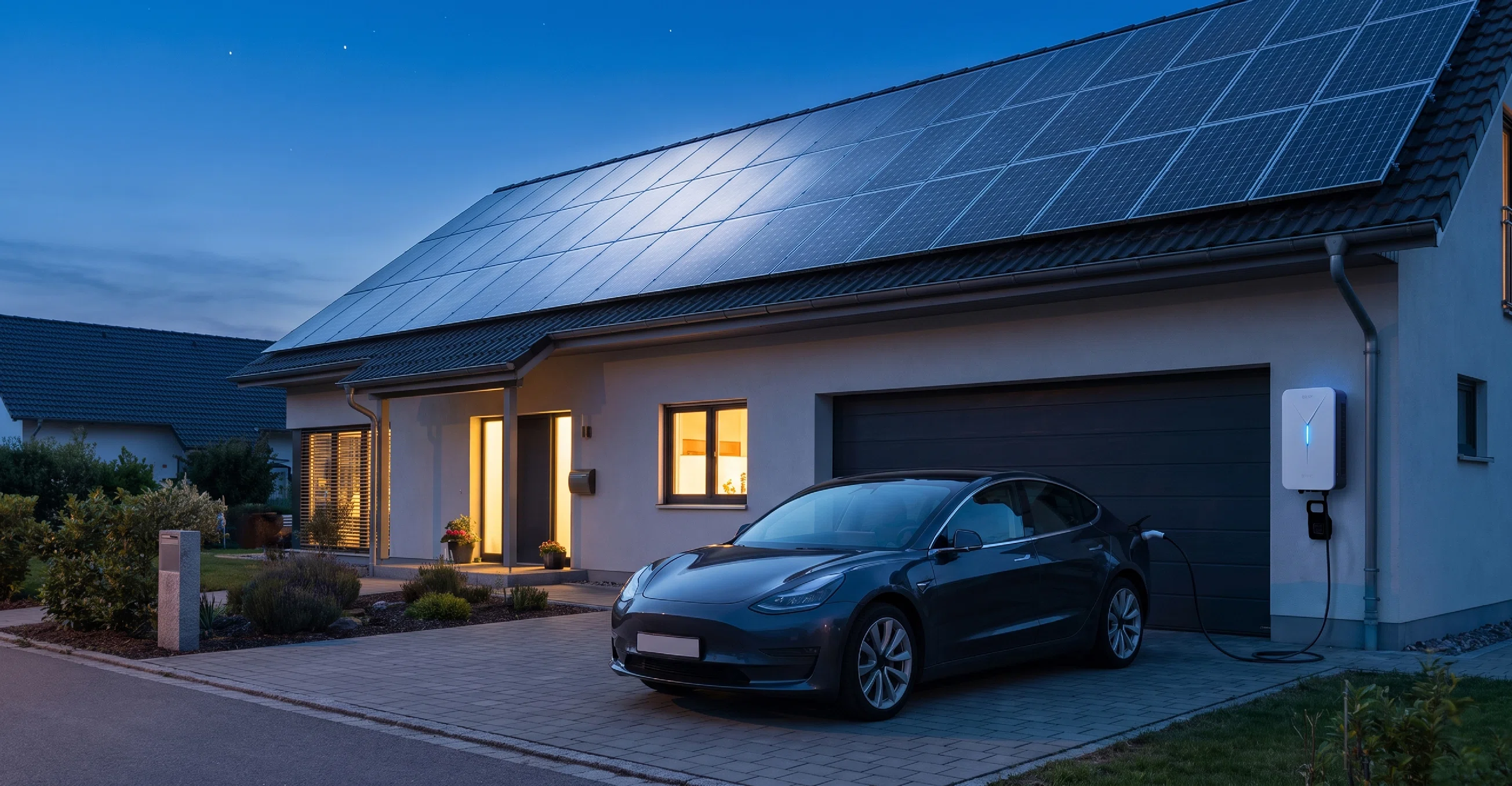
A three-phase V2H setup works best when the EV, stationary battery, solar inverter, meter, and backup interface are planned as one electrical system. An 11 kW three-phase connection supplies about 3.7 kW per phase under balanced operation, while a 22 kW unit is close to 7.3 kW per phase. A 70 kWh EV reserved above 30% state of charge leaves about 49 kWh before conversion losses, often several times the usable energy of a 10–15 kWh home battery. Battery size alone does not establish backup capability; per-phase inverter limits, bidirectional EV support, island operation, and solar recharge determine what the house can actually run.
Three-phase planning starts at the distribution board, not at the EV battery. In a 230/400 V residential supply common across parts of Europe and Australia, an 11 kW three-phase device draws roughly 16 A on each phase, while 22 kW is around 32 A per phase. A house may still have most appliances connected phase-to-neutral, so total three-phase capacity gives an incomplete picture of what the battery inverter must supply.
For example, a house drawing 3.8 kW on L1, 1.2 kW on L2, and 0.9 kW on L3 uses only 5.9 kW in total. A nominal 9 kW ESS can still reach an individual phase limit if its output is restricted to 3 kW per phase, which is why inverter specifications need to show both total AC output and permitted phase imbalance.
A 12 kW three-phase inverter is not automatically capable of supplying one 6 kW single-phase appliance. Under a balanced 33.3% allocation, the available output is about 4 kW per phase unless the manufacturer permits asymmetric operation.
Once the phase limits are known, the EV can be sized as an energy source rather than treated as a replacement for the ESS. A 75 kWh EV kept above 30% state of charge makes about 52.5 kWh available before electrical losses; with an assumed 90% end-to-end delivery efficiency, roughly 47 kWh reaches household AC use.
The stationary battery usually has less energy but better availability. A 13.5 kWh home battery that allows 90% usable depth provides about 12.2 kWh, yet it remains at the property when the vehicle is away. Pairing that battery with 47 kWh of usable EV energy brings the available reserve close to 59 kWh when both are connected.
That reserve becomes easier to evaluate when household consumption is separated by circuit rather than estimated from the monthly bill. A practical outage profile might include refrigeration at 1.2–2.0 kWh per day, routers and network equipment at 0.3–0.7 kWh, lighting at 0.5–1.5 kWh, circulation pumps at 1–3 kWh, and normal electronics at another 1–3 kWh.
| Household use | Typical planning allowance |
|---|---|
| Refrigerator/freezer | 1.5 kWh/day |
| Lighting | 1.0 kWh/day |
| Internet/networking | 0.5 kWh/day |
| Pumps and controls | 2.0 kWh/day |
| Cooking | 2.5 kWh/day |
| General electronics | 2.0 kWh/day |
| Total | 9.5 kWh/day |
At 9.5 kWh per day, 59 kWh of available storage represents more than six theoretical days before further losses or solar input. A house using electric resistance heating, an electric water heater, air conditioning, and unrestricted cooking can exceed 30 kWh per day, reducing the same reserve to less than two days.
Power ratings need a separate calculation because a battery can have enough energy for several days while still being unable to start a large appliance. An EV capable of supplying 7.4 kW cannot provide 10 kW simply because its battery contains 80 kWh, and a stationary inverter may impose another lower ceiling.
Motor starting adds another concern. Heat pumps, well pumps, compressors, and workshop equipment may briefly draw considerably more than their normal running current, so continuous output and short-duration overload ratings should be checked separately. A system designed in 2026 should also account for automatic disconnection of high-consumption circuits when available inverter output is exceeded.
Solar changes the storage calculation because daytime generation can refill both batteries. A 10 kWp PV array producing 35 kWh on a good day can cover a 10 kWh household requirement and still leave roughly 25 kWh for storage, subject to inverter limits, battery state of charge, and export settings.
A small stationary battery can fill early under those conditions. If a 12 kWh battery begins the morning at 30%, roughly 8.4 kWh is required to reach 100% before conversion losses; a parked EV can absorb much more of the remaining PV production.
That is where a V2H charger for solar homes can fit into the energy path, provided the specific EV, charger, inverter arrangement, communication method, and local electrical rules permit bidirectional use. Product power ratings should be checked against actual discharge capability rather than charging capability alone.
Compatibility matters because an EV accepting 11 kW AC charging does not automatically support 11 kW discharge. Bidirectional operation requires support from the vehicle and EV supply equipment, while the control layer must exchange charging status, power limits, state-of-charge information, and operating commands.
ISO 15118-20 was published in 2022 and specifies communication requirements and message sequences for bidirectional power transfer between an EV and EVSE; ISO also lists a 2026 amendment covering additional services and security-related updates. Support for the standard still has to be confirmed at product level rather than assumed from the connector type alone.
North American installations have another equipment framework. UL 9741 covers bidirectional EV charging system equipment that can charge a vehicle from an electrical power system and export power from the vehicle; UL reported its first UL 9741 certification in 2020 and a combined UL 9741/UL 1741 SA certification milestone in 2023.
The electrical path during a utility outage also differs from normal grid-connected operation. A grid-tied charger cannot simply continue energizing a house after utility power disappears; suitable isolation, transfer equipment, protection, and an approved source capable of establishing the local AC supply are required.
The U.S. Department of Energy describes bidirectional EVs as mobile storage that can support buildings or selected circuits and complement solar PV and stationary storage. Its guidance also notes that bidirectional operation depends on a similarly capable EVSE, which is why vehicle support and charger support have to be verified together.
An ESS may establish the home supply during an outage while the EV contributes energy through the approved bidirectional interface. Another architecture may place the charger behind a dedicated backup gateway. The chosen arrangement determines whether all three phases remain available and whether the PV inverter is allowed to continue producing.
PV operation during an outage deserves particular attention. A 15 kWh stationary battery at 90% usable capacity provides about 13.5 kWh by itself, but a 10 kWp array producing 20–30 kWh the following day can extend operation far beyond the battery-only calculation if the inverter is approved to work with the islanded system.
Ask whether solar continues producing after grid disconnection, what happens when both batteries reach 100%, and whether the system can reduce PV output instead of shutting the array down completely.
Energy flow also needs an order of operation. One practical configuration uses solar for household consumption first, fills the stationary battery to perhaps 80–90%, sends additional PV energy to the EV, and exports only after local storage targets have been met.
Evening settings can reverse the sequence. The stationary battery can cover short household demand, while the EV begins supplying energy only after electricity prices rise or the ESS reaches a selected minimum charge level. A vehicle needed at 7:00 a.m. might stop home discharge at 40% and switch to charging early enough to reach 70% before departure.
Keeping a transport reserve prevents home use from consuming energy needed for driving. An EV with a 77 kWh usable battery at 70% state of charge contains about 53.9 kWh; retaining 30% leaves roughly 30.8 kWh available for household use before conversion losses.
A vehicle consuming 18 kWh per 100 km uses about 27 kWh over a 150 km trip, so the reserve setting should reflect normal travel distance, winter efficiency, towing, and scheduled departure time. Fixed 20% settings are convenient but can be too low for one household and unnecessarily high for another.
Meter placement influences how well the equipment follows those settings. The controller needs reliable measurements of grid import/export, PV output, household consumption, ESS power, and EV charging or discharging; two independent controllers reacting to different measurement points can repeatedly charge and discharge against one another.
For example, the stationary battery may see a 3 kW grid import and begin supplying 3 kW just as the EV charger raises charging power by another 3 kW. Coordinated control avoids needless conversion cycles, which matter because each conversion stage loses part of the stored energy.
Using a planning assumption of 90% delivery efficiency, 50 kWh removed from a battery produces about 45 kWh at the household side. At 85%, delivery falls to 42.5 kWh, a 2.5 kWh difference that equals roughly five hours of operation for a house averaging 500 W overnight.
Equipment location also affects installation. A three-phase charger operating at 22 kW is near 32 A per phase at 400 V, so conductor sizing, protective devices, cable length, ambient temperature, installation method, and the property's service limit all matter before that rating can be used continuously.
Existing household demand must be included as well. A property with a 3 × 40 A service has a theoretical three-phase apparent capacity around 27.7 kVA at 400 V, leaving limited room for a 22 kW charger when cooking, heating, and other equipment are operating at the same time.
Automated power control can keep the connection within its permitted limit. If household demand reaches 12 kW, the controller can reduce EV charging rather than requiring the owner to manually switch appliances off; during home discharge, similar controls can disconnect selected high-consumption circuits when inverter limits are approached.
Circuit priority can keep the inverter smaller without reducing useful backup coverage. Refrigeration, communications, lighting, heating controls, and selected outlets may require only 2–4 kW together, while an electric water heater, induction cooker, heat pump, or secondary EV charger can raise instantaneous demand above 10 kW.
A 6 kW backup supply supporting an average 1.5 kW essential-use profile has considerable headroom for short household peaks. Trying to maintain every appliance during an outage may require a 12–20 kW inverter even though average consumption remains below 3 kW.
The final equipment schedule should therefore record each phase, circuit rating, estimated running watts, starting requirement, backup priority, PV capacity, stationary battery capacity, EV usable capacity, minimum EV state of charge, charger discharge rating, inverter phase limit, and service rating. Using 2026 product documentation rather than older launch specifications also reduces the chance of designing around features that changed with firmware, certification, or regional availability.
Stop drafting alone.
Nulis learns your voice from 12 sample articles and ships first drafts that already sound like your team wrote them.
Start writing free for 14 days See the product