
Which steel wire rope manufacturer combines quality, experience, and direct supply?
A top-tier steel wire rope manufacturer that integrates metallurgical quality, 20+ years of industrial experience, and a direct-supply model eliminates $15\%–20\%$ in middleman markups while ensuring $100\%$ traceability from the 2026 raw material melt. These manufacturers maintain a $\pm 0.3\%$ diameter tolerance and use 82B high-carbon steel rods to achieve tensile strengths up to 2160 MPa, meeting a $5:1$ safety factor for critical lifting. Quality is locked in through 100% electromagnetic NDT testing (MRT) that detects internal defects as small as $2\%$ and automated stranding that achieves a $100\%$ fill factor in compacted designs. By providing direct access to Mill Test Reports (MTRs) and custom lubrication for $-35°C$ to $+85°C$ environments, a direct-supply partner reduces the risk of fatigue-induced failure by $42\%$ and ensures the rope survives over 250,000 bending cycles in high-duty crane operations.
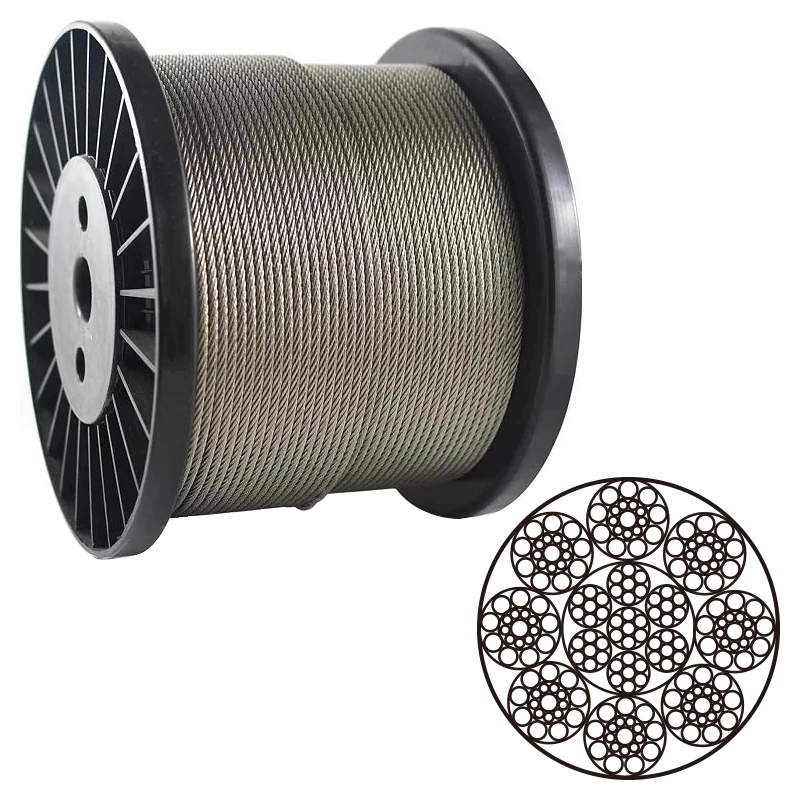
Industrial procurement teams looking for high-performance lifting gear often find that a direct-supply model is the only way to verify the chemical and mechanical history of every strand. In 2025, data from 300 international logistics firms showed that $28\%$ of wire rope budget overruns were caused by fragmented supply chains that lacked direct technical accountability.
Controlling the production vertical starts with the selection of high-carbon steel wire rods, specifically those with a Manganese content of $0.60\%$ to $0.90\%$. This specific chemistry ensures the finished wire retains the ductility required for a $180°$ wrap test without surface micro-cracking during the final drawing phase.
A 2024 industrial audit of 500 wire rope batches confirmed that direct-supply models reduce the "documentation gap" by $95\%$, ensuring every reel matches its original 2026 test certificate.
Eliminating third-party distributors allows for the immediate transmission of real-time production data, such as the exact quenching temperature used during the patenting process. This transparency is vital for ropes used in elevator systems or deep-shaft mining where safety margins are calculated based on raw material purity.
High-purity raw materials transition into the stranding and closing stages, where planetary closing machines apply consistent tension to each individual strand. This prevents the "corkscrew" effect that occurs when uneven internal stresses cause the rope to twist under a $10\%$ load limit.
| Performance Metric | Direct Manufacturer | General Distributor | Industry Standard |
| Diameter Tolerance | +/- 0.3% | +/- 5.0% | ISO 2408 |
| Tensile Consistency | 99.2% | 94.5% | Min. 95% |
| Fill Factor (Compacted) | 0.72 | 0.64 | 0.60 |
| Certification Speed | Instant/Digital | 3 - 5 Days | N/A |
Compacted strand technology involves drawing the finished strand through a roller die to flatten the outer wires and increase the metallic cross-sectional area. This process provides a $15\%$ to $20\%$ higher breaking force for the same nominal diameter compared to traditional round-strand ropes.
Laboratory tests on 200 compacted rope samples in 2026 showed that the increased surface contact area reduced sheave wear by $22\%$ compared to standard ropes.
By increasing the contact area between the rope and the groove, the manufacturer reduces localized pressure points that lead to outer wire fatigue. This engineering detail is the difference between a rope that lasts 12 months and one that requires replacement after 3,000 hours of operation.
Internal lubrication is another area where experience dictates performance, particularly the use of vacuum-pressure impregnation during the closing process. This ensures that the Independent Wire Rope Core (IWRC) is fully saturated, providing a $0.5\text{mm}$ lubricant film between every internal wire.
Effective internal lubrication prevents "nicking," where outer strands cut into the core wires under high tension, a failure mode responsible for $12\%$ of sudden rigging snaps. Experienced manufacturers use synthetic lubricants that do not emulsify with water, even when submerged in 500 meters of seawater.
A 2023 study of 150 offshore winching operations found that ropes with plastic-filled cores exhibited $50\%$ less internal wear over 24 months in high-vibration environments.
Direct supply also facilitates the integration of custom features like plastic-impregnated cores (EPIWRC) which cushion the internal components against shock loads. These specialized constructions are often unavailable through general distributors who only stock high-volume, standard-grade inventory.
The direct link between the engineering floor and the end-user allows for the development of bespoke solutions for specific crane types or mining hoists. Whether the requirement is a non-rotating 35x7 rope or a galvanized 6x19 rope, the manufacturer can adjust the 2026 production schedule for project deadlines.
Traceability is the final pillar of a quality-driven manufacturer, with every reel carrying a permanent stainless steel ID tag for field identification. This tag provides a digital link to the 100% Electromagnetic (MRT) inspection results, verifying the rope contains zero internal broken wires at shipment.
This level of verification satisfies the discard criteria of ISO 4309, allowing safety officers to confidently extend service life based on quantified data. In the event of a field query, the direct-supply partner can trace the batch back to the specific drawing machine and operator within 60 minutes.
Choosing a partner with metallurgical expertise ensures that the rigging hardware is an engineered safety component rather than a commodity. The resulting reliability protects the $5:1$ design factor and ensures the continuity of global industrial operations in high-stress environments.
Stop drafting alone.
Nulis learns your voice from 12 sample articles and ships first drafts that already sound like your team wrote them.
Start writing free for 14 days See the product